Where Is My Order? The Hidden Cost of Disconnected Data in Oil & Gas and Energy
It's Tuesday morning and a planner at the refinery is receiving a phone call. A vital valve is running late, the turnaround period begins on Friday, and the customer has one request of your team: a clear answer regarding the current position of the order.
The service representative opens the ERP, then the CRM, then the quality system, then the warehouse screen, and then the carrier portal. Twenty minutes later the answer is still only half completed.
The disorder in question isn't due to problems among people; it's a data issue, and in the fields of oil and gas and energy it's a costly one.
The Price of Waiting for Answers
Energy operations work according to strict schedules and involve expensive assets. Siemens believes that the cost of unexpected downtime amounts to $1.4 trillion each year for the world's 500 largest companies, which is 11% of their revenues, up from 8% in 2019. The oil and gas industry is particularly vulnerable since downtime costs increase when oil prices are high. vsightsiemens
The equipment side is just as constrained. According to Wood Mackenzie's second-quarter 2025 survey, the lead times for power transformers were around 128 weeks and those for generator step-up transformers about 144 weeks, with the survey projecting a 30% supply shortfall for power transformers that year. Since it takes the equipment so long to arrive, each delayed order is important, and each customer who questions it should receive a quick and accurate reply. eepower
Companies in the product sector experience this every day. Manufacturers of oilfield equipment, suppliers of pipes and valves, producers of chemicals and lubricants, suppliers of refined products, and distributors of after-market parts are all under similar pressure. Delayed pumps and valves lead to longer periods of downtime at rigs or refineries. The fact that sites are remote or offshore means that road access and the sailing of vessels are restricted. Oversized skids necessitate the use of special trailers and special permits, hazardous cargo requires carriers who are qualified for such transport, and one simple error at customs or in record keeping is enough to delay a shipment. When turnaround times are missed, maintenance schedules are disrupted, and premium freight charges and waiting fees gradually squeeze away the profit margin.
Although the problems may appear different, they have the same underlying cause since order, inventory, and shipment data are located in separate ERP, CRM, QMS, and WMS systems and this means that the various sites lose visibility during the handoffs involving trucks, ports, and vessels.
Why More Reporting Will Not Fix It
Most organisations already have a large number of reports but do not have linked evidence or well-defined responsibility. Productivity falls when service teams have to check the records in five different systems before they can respond, customers have to wait, and problems only become apparent after they have already caused damage.
Agentic AI, Applied with Discipline
Gartner forecasts that by 2028 at least 15 per cent of everyday work decisions will be made autonomously via agentic AI, which is an increase from 0 per cent in 2024. The same report also cautions that more than 40 per cent of agentic AI projects will be cancelled by the end of 2027 due to rising costs, an uncertain business value, or insufficient risk controls, and advises that agentic AI should only be pursued where it provides clear value or a return on investment. Gartner Predicts Over 40% of Agentic AI Projects Will Be Canceled by End of 2027 +2
The lesson is practical. Start with a focused use case, keep people in the decisions that matter, and build on a platform you already trust.
How Copilot Order Intel 360 Agent Helps
The way it thinks has led to the creation of CompQsoft Digital's Copilot Order Intel 360 Agent, a reusable accelerator based on the Microsoft Power Platform and Copilot Studio which combines order, inventory, and shipment data into a single answer that is sourced and available within Teams. In practice, it operates as follows:
- When representatives inquire about an order, they are given evidence that has been sourced rather than receiving guesses.
- The case workspace in Power Apps records the request and sets up a tracked case based on the conversation.
- Exceptions and approval requests are sent to the appropriate person through Microsoft Teams, where your team already carries out their work.
- The manager's dashboard displays case ownership, progress, and order risk exposure.
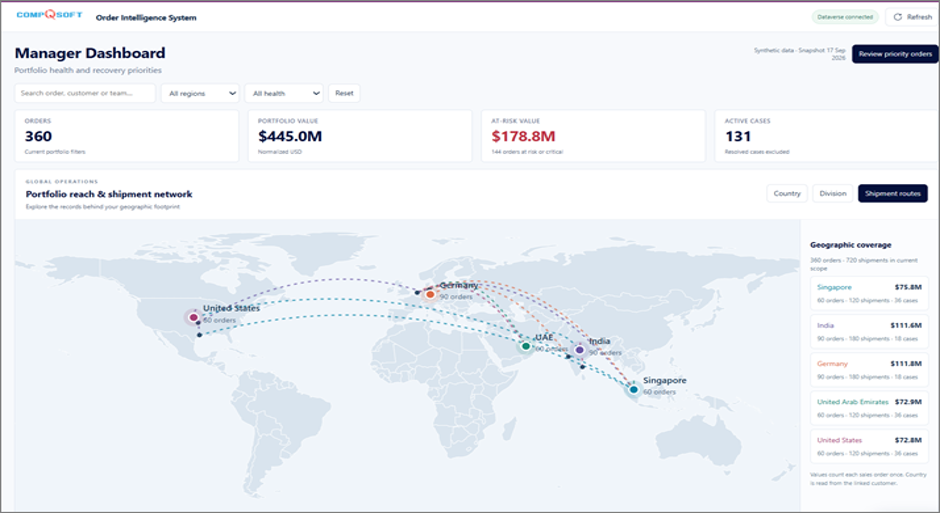
If a refinery contact enquires regarding a delay in the valve order, the agent looks at the sourced order, the inventory and the shipment records, discovers that a material certificate is missing, and then opens a case in Teams. The owner is informed and the representative agrees with the customer a recovery plan before the turnaround period begins. The entire process is supervised by authorized persons concerning technical product selection, quality release, hazardous goods and trade decisions.
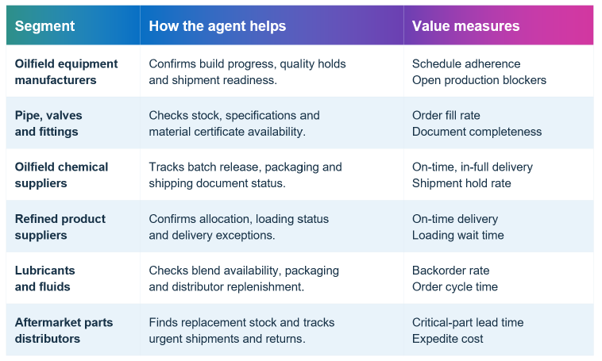
The value is seen differently throughout the product ecosystem. Equipment manufacturers are able to verify build progress, quality holds, and readiness for shipment. Suppliers of pipes, valves, and fittings can check their stock, specifications, and the availability of certificates. Chemical and lubricant suppliers can monitor batch release, packaging, and the status of the shipping documents. Refined product suppliers can confirm allocation, loading, and delivery exceptions, while aftermarket distributors can locate replacement stock and keep track of urgent shipments. Proposed measures are schedule adherence, order fill rate, on-time, in-full delivery, and critical-part lead time. These are performance indicators to track, not promises of results.
Since the agent is based on the tools you already possess, there's no need to carry out a multi-year ERP, CRM, or shipping overhaul. The ready-made wireframes and the engineered assets also assist business and IT teams in agreeing on common use cases and enable them to proceed more quickly.
Value Across the Oil & Gas Order Lifecycle
See It in Action
It's not necessary for oil and gas and energy teams to search for answers across five different systems in order to let a customer know where an order is.
Join CompQsoft Digital and Microsoft for our webinar, "How Agentic AI Is Transforming Customer Experience in Oil & Gas and Energy," and find out how the Copilot Order Intel 360 Agent links your order data, creates a trail of shared evidence, and enables your team to stop hunting around for order risks and start addressing them.


Comments